We may earn a commission when you buy through links on this page, at no extra cost to you. How this works.
Lithonia Lighting 4 ft. 2-Light T8 or T12 Fluorescent White Multi-Volt Strip Light Fixture
Can you really skip the pricey grow lights and use basic shop lights for seed starting?
Use the matching tool first
Start with Beginner Organic Garden Setup Checklist if you want to narrow the fit before checking current offers.
I wasted forty-three dollars my first year because I believed the marketing.
The grow light companies show you these lush, perfect seedlings bathed in purple light. The forums are full of people insisting you need full-spectrum this and PAR rating that. Meanwhile, my neighbor Eleanor-yes, we share a name, it's confusing at church-was growing tomatoes under the same shop lights she used in her garage.
Her seedlings were stockier than mine.
Here's the truth most gardening sites won't tell you: for seedlings specifically, the difference between a budget shop light and a grow light matters far less than you think. But the gap isn't zero, and knowing where that gap actually exists will save you both money and leggy, disappointing transplants.
The real answer depends on three things: what you're growing, how long you need to keep plants under lights, and whether you're renting or own your space. Let's walk through this like we're standing in the hardware store together, because that's exactly where this decision happens.
What Seedlings Actually Need (It's Simpler Than You Think)
Seedlings are not houseplants. They're definitely not fruiting tomato plants. They're babies with very specific, temporary needs.
For the first 4-8 weeks of life, seedlings need:
- Bright light for 14-16 hours daily to prevent stretching
- The right color temperature-between 5000K and 6500K, which mimics spring sunlight
- Consistent proximity to the light source, usually 2-4 inches above the foliage
Notice what's not on that list? Full-spectrum light. PAR ratings above 200. Red and blue wavelength ratios.
Those matter tremendously if you're growing plants to maturity indoors. But for seedlings that will spend their adult lives in your garden, you're just trying to get them through adolescence without them becoming weak and spindly. According to research from both Kansas State University and the University of Missouri Extension, standard fluorescent lights in the 'daylight' range provide completely adequate light for seed starting.
The North Carolina State Extension explicitly states that 'cool white' fluorescent bulbs work well for starting seeds. This is important because it means the least expensive lighting option can genuinely work.
So why does anyone buy grow lights? Because there are real advantages-just not the ones advertised.
The Shop Light Approach: Cheap, Proven, Slightly Annoying
A shop light is just a basic fluorescent or LED fixture designed for workshops and garages. You've seen them. They're unglamorous, institutional, and they cost about the same as a bag of chicken feed.
The advantages are real. Shop lights are available everywhere-any hardware store, any time. They use standard T8 bulbs, which means if something breaks, you replace a five-dollar bulb instead of a forty-dollar fixture. And if you already have one hanging in your basement, you're literally done shopping.
The key is bulb selection. You want T8 LED bulbs marked 'daylight' or '6500K.' Not 'soft white,' not 'warm.' Those yellowy bulbs will grow you leggy, sad seedlings that fall over when you breathe near them. Ask me how I know.
The downsides? Most shop lights need to be hardwired or at least lack convenient on/off switches. You'll be plugging and unplugging, or you'll need to add a timer separately. They're also heavy and require actual installation-screws, anchors, the whole bit. This is fine if you own your home and have a dedicated seed-starting area. It's a dealbreaker if you're renting or want something portable.
And here's the thing nobody mentions: shop lights are bright in a way that can be unpleasant if your seed setup is in a living space. That blue-white industrial light at full blast in your dining room for 16 hours a day gets old fast.
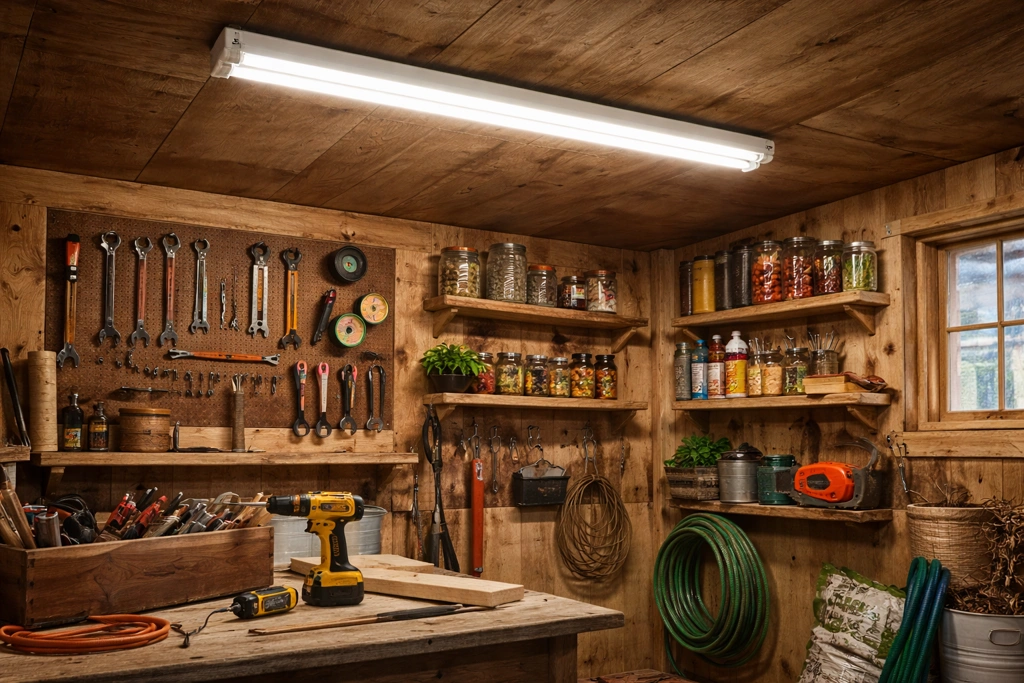
Lithonia Lighting 4 ft. 2-Light T8 or T12 Fluorescent White Multi-Volt Strip Light Fixture
This is the shop light I keep coming back to, mostly because it refuses to die and costs about the same as a bunch of kale at the farmer's market.
The Lithonia fixture is dead simple-a metal housing that holds two 4-foot T8 bulbs. That's it. No frills, no features, no nonsense. You'll need to buy the bulbs separately, and you'll need to hardwire it, which means this isn't a plug-and-play option. If you're renting or uncomfortable doing basic electrical work, this one's not for you.
But if you have a permanent seed-starting shelf in a basement or garage? This is the most economical long-term solution. When a bulb eventually burns out, you replace just the bulb. The fixture itself will outlive your interest in gardening.
I'm running two of these over a wire shelving unit, each with a pair of 6500K T8 LED bulbs. My tomatoes, peppers, and brassicas all started under them, and I've never had a leggy seedling problem that wasn't my own fault for not adjusting the height soon enough.
The total cost runs about $35-40 once you add bulbs. Not the absolute cheapest option, but the durability and replaceability make it a smart pick for a long-term setup.
- ✅ The fixture itself is extremely inexpensive, making it the most frugal option for a homesteader willing to do a little extra setup work.
- ✅ You can choose your own T8 LED bulbs, allowing you to select the ideal 'daylight' color temperature (6500K) and brightness for optimal seedling growth.
- ✅ If a bulb fails, you only need to replace the inexpensive bulb, not the entire light fixture, saving money over the long term.
- ✅ The simple, durable steel housing is built for utility spaces like basements or garages and can withstand years of use.
- ⚠️ The required T8 bulbs are sold separately, so the total startup cost is higher than the price of the fixture alone.
- ⚠️ This unit must be hardwired into your home's electricity; it does not come with a plug and is not suitable for renters or those uncomfortable with electrical work.
- ⚠️ It lacks convenience features like a pull chain or switch, requiring you to add your own or connect it to a switched outlet.
The LED Grow Light Approach: Convenient, Flexible, Pricier
LED grow light strips changed the game for renters and people without dedicated growing spaces.
Unlike the hardwired shop lights, most LED grow strips are true plug-and-play. They come with adhesive backing or hanging hardware, connect together easily, and can be set up on any wire shelf in about ten minutes. When you're done for the season, you can take them down and store them. When you move apartments, they move with you.
The light quality is genuinely better for plant growth. That full-spectrum output includes more red wavelengths, which does encourage slightly sturdier stem development and better leaf color. For seedlings, this is a nice-to-have, not a must-have. But if you're also growing lettuce, herbs, or microgreens indoors to maturity, that spectrum advantage becomes significant.
The tradeoff is cost and longevity. You're paying for the convenience and the optimized spectrum. And when an LED strip fails-and they do, usually at the connection points-you're replacing a whole unit, not a five-dollar bulb.
The energy efficiency is real, though. Running six 10-watt LED strips for 16 hours a day costs about three dollars a month. The same light output from T8 fluorescents would be closer to six or seven dollars monthly. Over a decade, that adds up.
For beginners, for renters, for people who want a system they can actually see working without doing electrical work-this is the path.
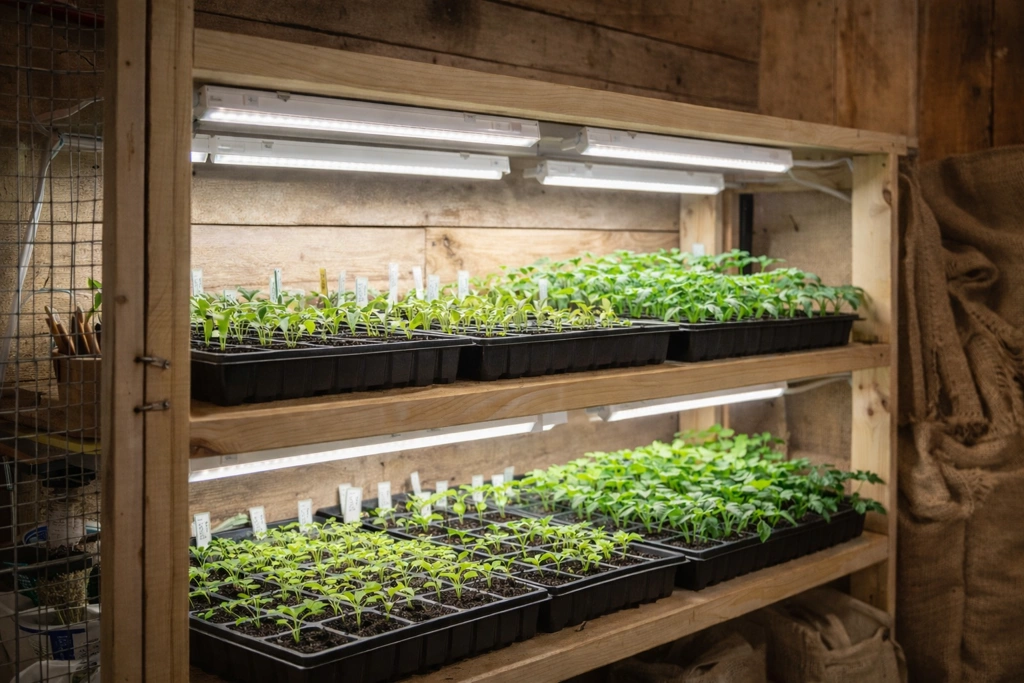
Barrina T5 Grow Lights, Full Spectrum, 2ft 80W (8 x 10W, 500W Equivalent), LED Plant Light for Indoor Plants, Greenhouse, Seed Starting, Plug and Play, Yellow
I installed these on a wire shelf last March, and my first thought was 'this is almost too easy.'
The Barrina kit gives you eight 2-foot LED strips that link together with simple connectors. Each strip has adhesive backing and also includes zip ties, so you can attach them to wood, metal, or whatever shelf setup you're working with. No tools. No hardwiring. Just peel, stick, and plug in.
The light output is legitimately full-spectrum, and you can see it-the color is a warm yellowish-white rather than the harsh blue-white of shop lights or the weird purple of cheaper grow lights. My seedlings responded beautifully. Compact growth, deep green leaves, strong stems.
At 10 watts per strip, these are wildly energy-efficient. I ran all eight for 16 hours daily and barely noticed a difference in my electric bill. For seedlings and greens, the light intensity is perfect. But know this: you cannot grow a tomato plant to fruiting maturity under these. The wattage just isn't there. These are for seedlings, lettuce, herbs, and microgreens.
The cable management is honestly my only real complaint. Eight strips mean multiple cords and connectors, and on a wire shelf, they want to droop and tangle. I ended up using binder clips and more zip ties than I'd like to admit. It works, but it's not beautiful.
For someone starting their first seed setup, or for a renter who needs something portable, this kit is nearly perfect. It sits in that sweet spot between 'too cheap to work' and 'more than you need for seedlings.'
- ✅ Provides a full spectrum of light specifically for plants, promoting healthier and more robust seedling development compared to a standard shop light.
- ✅ The kit includes eight separate 2-foot light strips, offering the flexibility to customize lighting across multiple shelves or seed trays.
- ✅ Very low power draw (10 watts per strip) is highly energy-efficient, making it affordable to run them for the required 14-16 hours per day.
- ✅ Installation is extremely beginner-friendly with included adhesive pads, zip ties, and simple plug-in connectors, requiring no tools or technical skill.
- ⚠️ The low 10-watt power per strip is ideal for seedlings and lettuce but lacks the intensity needed to grow more demanding plants like tomatoes or peppers to maturity.
- ⚠️ Connecting multiple strips results in numerous cords and connectors, which can be difficult to organize neatly on a wire shelf.
- ⚠️ The lightweight plastic construction is less durable than a steel shop light fixture. This product is best for someone who won't be moving it frequently.
Which One Should You Actually Buy?
Here's how I'd make the call:
Choose shop lights with T8 LEDs if:
- You own your home and have a permanent seed-starting location
- You're comfortable doing basic electrical work or hiring someone
- You want the absolute lowest long-term cost
- You're starting a lot of seeds and need serious coverage
Choose LED grow light strips if:
- You're renting or might move your setup
- You want plug-and-play simplicity with no tools
- You're also growing greens or herbs indoors beyond seedling stage
- You value flexibility and portability over rock-bottom cost
Both will grow excellent seedlings. I've used both. I currently use both in different locations for different purposes.
The shop light is on my permanent basement shelf where I start 200+ plants every spring. The LED strips are in my kitchen on a small wire rack where I grow salad greens and keep a few herbs going through winter. Each one is perfect for its context.
The worst choice is spending six weeks researching and then starting your seeds too late because you were paralyzed by options. Seedlings need light and attention, not perfect equipment.
Setup Essentials (Either Option)
- Wire shelving unit or sturdy table to hold trays and lights
- Timer (mechanical or digital) to maintain consistent 14-16 hour light schedule
- Adjustable chains or rope to raise lights as seedlings grow
- Surge protector if running multiple fixtures
- Thermometer to monitor temperature near seedlings (65-75°F ideal)
- Method to raise/lower light fixture to keep 2-4 inches above seedlings
The Mistakes I Made So You Don't Have To
My first year, I mounted the shop lights and never adjusted them. The fixtures stayed fixed while my tomato seedlings stretched toward them like desperate little supplicants. They were five inches tall and flopped over if you looked at them wrong.
Lights need to move with your plants. As seedlings grow, the light should stay 2-4 inches above the top leaves. I use cheap lightweight chain from the hardware store and S-hooks. Takes two seconds to adjust, makes all the difference.
Second mistake: I used 'soft white' bulbs in my shop light because they were cheaper. The color temperature was too warm, around 3000K instead of 6500K. Everything got leggy. Color temperature matters more than I wanted to admit.
Third mistake: no timer. I would forget to turn the lights on until noon, or I'd leave them on for 20 hours because I got busy. Inconsistent light schedules stress seedlings. A fifteen-dollar mechanical timer solved this completely and I should have bought one on day one.
Fourth mistake: believing that more light is always better. I put the lights one inch above my pepper seedlings. Burned the tips of the leaves. Even seedlings can get too much of a good thing when it's too close.
Learn from my chaos. Use a timer. Get the right color temperature. Adjust the height. Your seedlings will reward you with thick stems and deep green leaves.