We may earn a commission when you buy through links on this page, at no extra cost to you. How this works.
Espoma Organic Seed Starter Premium Potting Mix
Make your own organic seed starting mix or buy it? Here's what actually works.
Use the matching tool first
Start with Beginner Organic Garden Setup Checklist if you want to narrow the fit before checking current offers.
I killed my first three trays of tomato seedlings using regular garden soil. Just scooped it from the yard, patted myself on the back for being resourceful, and watched everything dampen off within ten days.
That expensive lesson taught me something crucial: seed starting mix isn't just dirt made fancy for profit. It's engineered for a very specific, vulnerable phase of plant life. Your seeds need something light enough for fragile roots to push through, sterile enough to prevent disease, and moisture-retentive enough to keep things from drying out during those critical first weeks.
The question isn't whether you need proper seed starting mix. You do. The real question is whether you should mix your own or buy a bag.
For homesteaders, this decision comes down to more than convenience. It's about cost per tray, ingredient transparency, sustainability concerns, and whether you have the time and space to source and store components. I've done both methods for years now, and each has its place depending on your situation.
Let's walk through a reliable DIY recipe first, then look at the three best organic store-bought options that actually deliver on their promises.
The DIY Route: A Proven Recipe for Organic Seed Starting Mix
Making your own seed starting mix gives you complete control over what touches your future food. It's also significantly cheaper if you're starting more than a few dozen seedlings.
Here's the recipe I've used successfully for five seasons running:
- 4 parts coconut coir (the sustainable peat alternative that rehydrates beautifully)
- 1 part perlite (for drainage and aeration-don't skip this)
- 1 part screened compost (fully finished, ideally from your own pile)
- Optional: 1 tablespoon kelp meal per gallon (gentle nutrient boost for later growth)
The coconut coir comes in compressed bricks. You'll need to rehydrate it in a bucket with warm water-this takes about 20 minutes and makes a surprising amount of fluffy material. The perlite keeps everything from compacting. And that screened compost? It needs to be truly finished and ideally heated to kill pathogens. If you're not confident in your compost, this is where homemade mixes get risky.
Mix everything thoroughly in a large tub or wheelbarrow. I do this outside because perlite dust is not something you want to breathe. Moisten the blend until it's damp but not soggy-it should hold together when squeezed but break apart easily.
The honest drawbacks: This takes space to store components, time to mix, and requires sourcing quality ingredients. If your compost isn't properly finished, you risk introducing diseases or weed seeds. I learned this the hard way when volunteer tomatoes sprouted in my pepper trays. Also, you'll need to buy components in bulk to make the economics work, which means upfront investment and storage space.
When DIY makes sense: You're starting 100+ seedlings, you have reliable compost, you enjoy the process, and you have space to store a bale of coir and a bag of perlite. The cost drops to roughly 30-40% of store-bought mix at scale.
Why Store-Bought Mix Isn't Cheating
There's a certain homesteading pride in making everything from scratch. I get it. But buying a quality organic seed starting mix isn't a failure-it's often the smarter choice.
Store-bought mixes are formulated for consistency. They're sterilized. They're tested. And for anyone starting fewer than 50 seedlings, or without space for ingredient storage, or simply short on time in February when seed starting actually happens, they're the practical choice.
The trick is choosing one that actually lives up to the 'organic' label and performs well. I've tested roughly a dozen brands over the years. Most are fine. A few are exceptional. Three consistently rise to the top, and those are what I'm recommending here.
Each has different strengths depending on your specific needs and values-whether that's sustainability, ease of use, or giving seedlings the absolute best nutritional start.
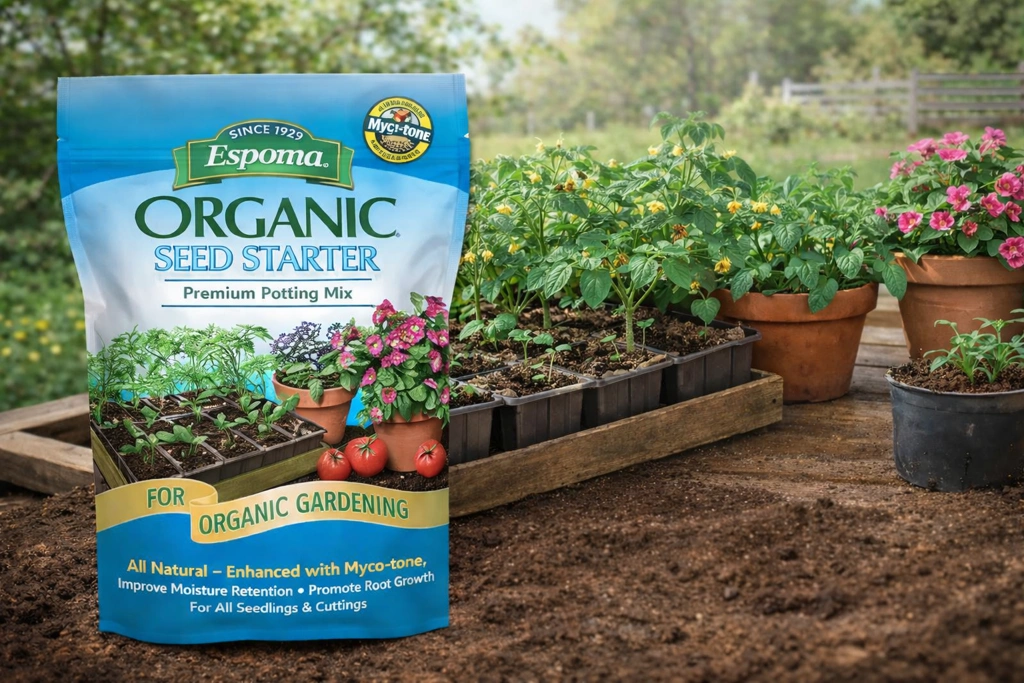
Espoma Organic Seed Starter Premium Potting Mix
This is the mix I grab when I need reliability without thinking too hard about it. Espoma has been in the organic game long enough to understand what seedlings actually need, and their seed starter reflects that experience.
The base is sphagnum peat moss blended with humus and perlite-a classic combination that works. What sets it apart is the addition of their proprietary Myco-tone mycorrhizae. These beneficial fungi colonize seedling roots and essentially extend their reach, helping them access more water and nutrients than they could on their own.
The texture is beautifully fine, which matters more than you'd think. Large chunks or woody bits can create air pockets or block delicate roots. This mix is consistently smooth, though I have occasionally found a small twig or two in certain bags. For tiny seeds like lettuce or herbs, I'll sometimes give it a quick sift, but for most vegetables it works perfectly as-is.
The moisture retention is excellent. I've had trays of this mix sit for several days between waterings without the surface crusting over or seedlings showing stress. That's crucial during germination when consistent moisture makes or breaks success rates.
The peat moss base does give me a small sustainability twinge. Peat bogs regenerate incredibly slowly, and their harvest has legitimate environmental consequences. If that's a dealbreaker for you, skip to the Burpee option below. But Espoma's organic certification is legitimate-it's OMRI Listed, meaning it meets strict standards for use in organic food production.
One practical warning: keep this mix evenly moist but not soggy. The peat base, combined with indoor conditions, can encourage fungus gnats if you overwater. A small fan for air circulation helps tremendously.
- ✅ The added mycorrhizae creates a symbiotic relationship with seedling roots, helping them absorb more water and nutrients for stronger, faster growth.
- ✅ Being OMRI Listed provides confidence that you are starting your food garden without synthetic pesticides or fertilizers.
- ✅ The fine texture is ideal for delicate, new seeds, allowing roots to easily penetrate and establish themselves without struggling against clumps.
- ✅ Its formulation provides excellent moisture retention, which helps prevent seeds from drying out during the critical germination phase.
- ⚠️ The primary ingredient is peat moss, which raises sustainability concerns for some environmentally-conscious growers due to its slow regeneration.
- ⚠️ Like many peat-based mixes, it can be prone to developing fungus gnats if the soil is kept too wet indoors.
- ⚠️ Some batches may contain small twigs or wood fragments that need to be sifted out before planting very fine seeds. Avoid for tiny herb or flower seeds unless you sift it first.
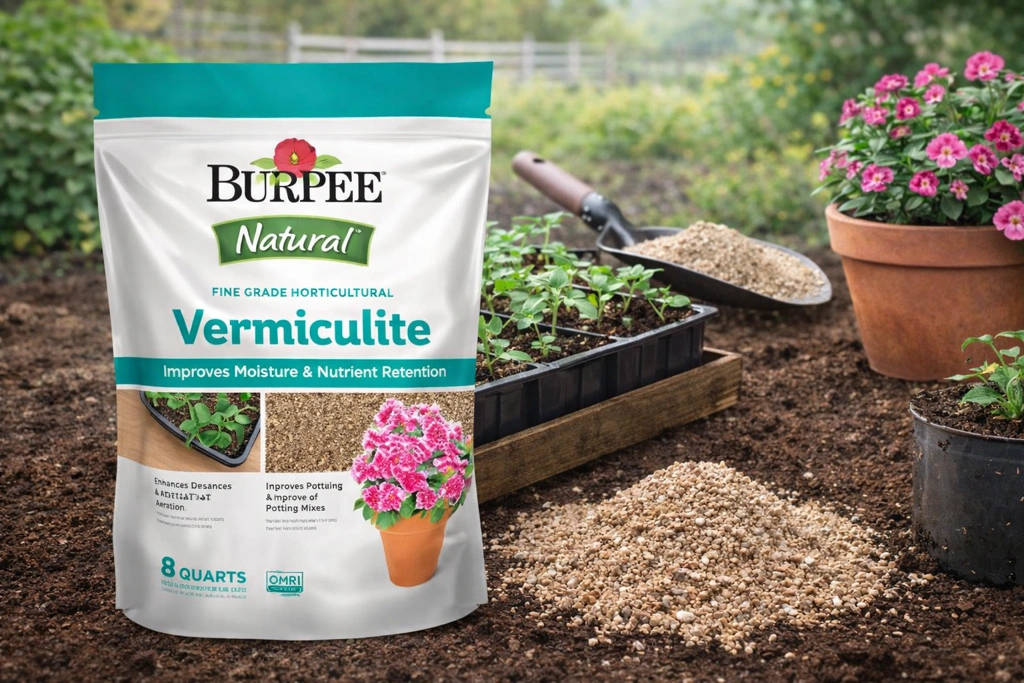
Burpee Organic Vermiculite Seed Starting Mix
If sustainability is high on your priority list, this is your mix. Burpee built this formula around coconut coir instead of peat moss, which immediately addresses the biggest environmental concern with seed starting mixes.
Coconut coir is a byproduct of coconut processing-essentially recycled material that would otherwise be waste. It's renewable, and it performs beautifully for seed starting. The aeration and drainage it provides are actually superior to peat in my experience. Overwatering is harder to do, and root rot is less of a concern. For beginners who tend to love their seedlings a bit too enthusiastically with the watering can, this is a safety net.
The mix comes compressed, so you'll need to fluff it and add some water before use. This isn't difficult-just an extra step. I usually dump a bag into a large tub, work it with my hands to break up clumps, and add water gradually until it's evenly moist. Takes maybe ten minutes.
One quirk of coir: if you let it dry out completely, it can become hydrophobic-meaning water beads off rather than absorbing. The fix is simple (thoroughly soak it until it rehydrates), but it's something to be aware of. Don't let your trays go bone-dry and you'll be fine.
The mix includes a light fertilizer, which is helpful once seedlings develop their first true leaves and start needing nutrition beyond what the seed itself provides. For most vegetables this is perfect. For extremely sensitive seeds or if you're a purist who wants to control every input, this might feel like too much hand-holding. Personally, I appreciate not having to think about feeding for the first few weeks.
Burpee's organic certification is solid-it's OMRI Listed just like the Espoma. And at its typical price point, it's competitive with the peat-based options while being more environmentally responsible. That's a trade-off I'm happy to make.
- ✅ Uses sustainable coconut coir as its base, making it an excellent peat-free choice for gardeners concerned with the environmental impact of peat harvesting.
- ✅ Coir provides fantastic aeration and drainage, which helps prevent root rot from overwatering-a common issue for beginners.
- ✅ It is OMRI Listed, ensuring it meets strict organic standards suitable for growing your own food.
- ✅ Includes a light fertilizer, providing gentle nutrients to seedlings right after they develop their first true leaves, eliminating the need for immediate feeding.
- ⚠️ Coconut coir can become hydrophobic (water-repellent) if it dries out completely, requiring a thorough soaking to rehydrate.
- ⚠️ The mix often ships compressed and needs to be fluffed and moistened before use, which is an extra step compared to ready-to-use mixes.
- ⚠️ The included fertilizer may be too strong for extremely sensitive seeds, such as certain herbs or alpine flowers. Not ideal for growers who prefer complete control over feeding.
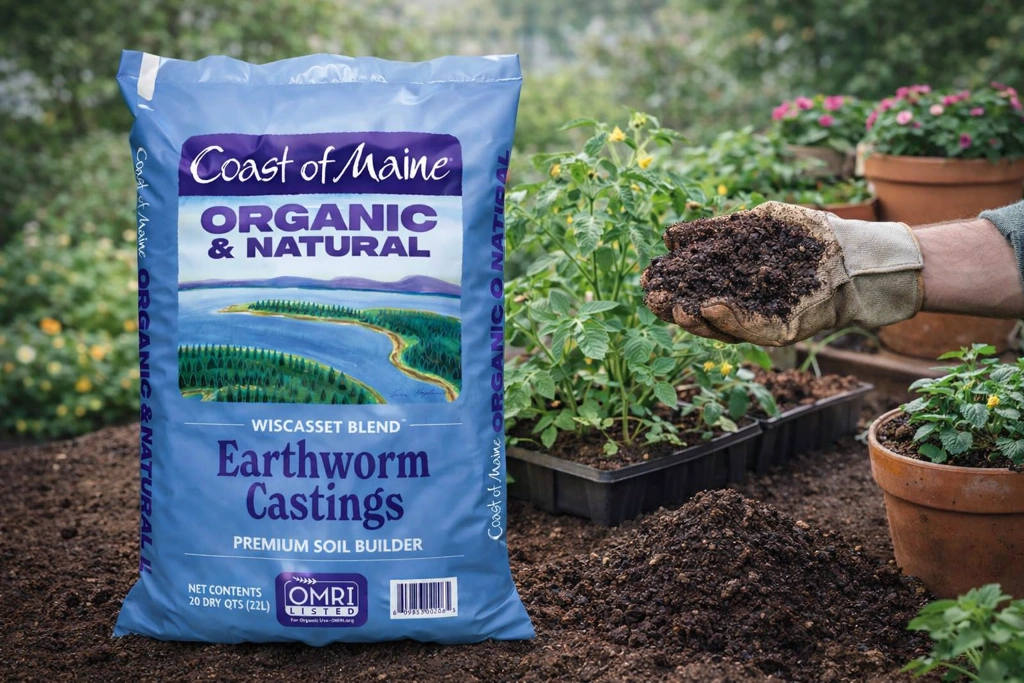
Coast of Maine Wiscasset Blend Organic Seed Starter
This is the premium option, and you can feel the difference the moment you open the bag. The texture is consistently fine and fluffy, with a richness that comes from the inclusion of worm castings and kelp meal alongside the standard peat and perlite base.
Those additions aren't just marketing fluff. Worm castings are essentially nature's slow-release fertilizer, providing gentle, bioavailable nutrients that won't burn tender roots. The kelp meal adds trace minerals and natural growth hormones that promote strong, stocky seedlings rather than leggy, weak ones. If you've struggled with seedlings that stretch toward the light and flop over, better nutrition from day one actually helps.
The biological activity in this mix is noticeable. It smells earthy and alive rather than inert. This fosters a healthy soil microbiome from the start, which translates to more resilient plants that can better resist stress and disease once transplanted.
I particularly love this mix for soil blocking-a technique where you compress the mix into cubes without any container. The Coast of Maine blend holds its shape beautifully for this purpose while still being loose enough for roots to penetrate easily. If you're trying to eliminate plastic pots from your operation, this mix performs exceptionally well for that method.
The downsides are practical rather than performance-related. This mix costs noticeably more per quart than the other two options. For someone starting a few dozen seedlings, that's a marginal difference. If you're doing hundreds of plants, it adds up quickly. Availability can also be spotty-I've had to order it online when local stores were out, while Espoma and Burpee are nearly everywhere.
The rich organic matter can attract fungus gnats in humid indoor conditions, just like the Espoma. Good air circulation and proper watering practices solve this, but it's worth noting.
If you want to give your seedlings the absolute best start and don't mind paying a bit more for measurably better ingredients, this is the mix to choose.
- ✅ Includes nutrient-rich ingredients like worm castings and kelp meal, which provide a gentle, slow-release food source for robust seedling development.
- ✅ The fine, uniform texture works exceptionally well in soil blockers, a popular, sustainable method that eliminates the need for plastic pots.
- ✅ Being OMRI Listed assures users that the mix is free from synthetic chemicals, aligning with the goal of growing clean, organic food.
- ✅ The biologically active ingredients help foster a healthy soil microbiome from the very beginning, leading to more resilient plants.
- ⚠️ This is a premium mix and is typically more expensive per quart than many other brands.
- ⚠️ Its availability can be limited, often found at specific garden centers or Home Depot rather than being ubiquitously available.
- ⚠️ The rich organic matter can sometimes attract fungus gnats, especially in humid indoor environments. Avoid if you are highly sensitive to indoor pests.
Which Approach Actually Makes Sense for You?
I wish there was a single right answer here, but homesteading rarely works that way. The best choice depends on your specific situation, and being honest about your constraints is more valuable than following someone else's ideology.
Choose DIY if: You're starting more than 75-100 seedlings, you have reliable finished compost, you have storage space for bulk ingredients, and you genuinely enjoy the mixing process. The economics favor you at scale, and the ingredient control is real. Just don't fool yourself into thinking it's quick or easy the first few times.
Choose Burpee if: Sustainability is your top priority and you want to avoid peat moss entirely. The coir base is legitimately more renewable, the performance is excellent, and the price is reasonable. The built-in fertilizer is a nice touch for beginners.
Choose Espoma if: You want proven, reliable performance without overthinking it. The mycorrhizae addition is legitimately beneficial, it's widely available, and it works consistently well across different seed types. This is my default recommendation for most people.
Choose Coast of Maine if: You're committed to giving seedlings the absolute best start, you're willing to pay more for premium ingredients, or you're using soil blocking methods. The biological richness makes a noticeable difference in seedling vigor.
I keep both DIY ingredients and a bag of Espoma on hand. For my big spring planting of tomatoes, peppers, and brassicas, I mix my own. For succession plantings, herb experiments, or when I'm simply short on time in the chaos of homestead spring, I grab the bag. There's no homesteader badge for making things harder than they need to be.
Key Reminders for Seed Starting Success
- Never use regular garden soil for seed starting-it's too heavy and can harbor diseases
- Moisten your mix before filling trays so you don't wash seeds away when watering
- Label everything immediately-you will not remember which tray is which variety
- Bottom watering prevents damping off disease better than top watering
- Seeds need consistent warmth to germinate, but most seedlings prefer it cooler once sprouted
- A small fan for air circulation dramatically reduces fungus gnat problems and strengthens stems
The Mix Matters More Than You Think
That first year when I killed those tomato seedlings with yard dirt taught me something that's served me well across all of homesteading: some shortcuts aren't actually shortcuts. They're just longer routes to failure.
Proper seed starting mix-whether you make it or buy it-isn't an optional upgrade. It's the foundation of your entire growing season. Every plant that feeds your family this summer starts in those few tablespoons of soil. Getting it right means strong transplants, better yields, and fewer headaches.
The good news is that once you settle on an approach that works for your situation, it becomes routine. I don't debate this decision anymore. I know what I'm using based on how many plants I'm starting and what else is demanding my attention that week. The thinking is done.
Focus your energy on choosing good seed varieties, getting your timing right, and managing light and water properly. The soil beneath those seeds? That's handled.