We may earn a commission when you buy through links on this page, at no extra cost to you. How this works.
I spent an embarrassing amount of time last February standing in a garden center aisle, staring at a wall of containers. Fabric grow bags on one side, plastic pots on the other. Both promised to be the answer to my tomato-growing prayers.
Here's the thing nobody tells you upfront: both work. But they work differently, and which one is 'best' depends entirely on what you're growing, where you're growing it, and how much time you actually have for watering.
After three seasons testing both types across our homestead garden-with vegetables, herbs, and even a few experimental potato towers-I've learned that the fabric vs. plastic debate isn't about picking a winner. It's about matching the container to your specific situation.
Let's break down what actually matters: root health, water management, durability, and the costs that add up over time. No marketing fluff, just what worked and what didn't.
Use the matching tool first
Start with Beginner Organic Garden Setup Checklist if you want to narrow the fit before checking current offers.
How Root Systems Behave Differently
The biggest functional difference between fabric and plastic isn't what you see on the surface-it's what happens underground.
In traditional plastic pots, roots grow until they hit the wall, then circle around the inside edge. You've probably seen this if you've ever unpotted a root-bound plant: a dense spiral of roots with very little soil left in the center. This 'root circling' can stress plants and limit nutrient uptake, especially in smaller containers.
Fabric grow bags change this pattern through a process called 'air pruning.' When roots reach the breathable fabric wall and encounter air, the root tips naturally die back. Sounds bad, but it's actually genius. The plant responds by sending out new lateral roots, creating a much denser, more fibrous root system instead of a tangled mess.
I noticed this most dramatically with peppers. My fabric-grown plants had noticeably bushier root balls with better branching, while the plastic-potted ones showed that telltale circling pattern. Research from the University of New Hampshire Cooperative Extension confirms that air pruning typically produces healthier root architecture and better nutrient absorption.
Does this translate to bigger harvests? Sometimes. My tomatoes in 10-gallon fabric bags outyielded identical varieties in plastic pots by about 15-20%, though that gap narrowed when I moved up to larger plastic containers. For root crops like potatoes, the fabric bags were clearly superior-easier to harvest and better tuber development.
The Watering Reality No One Warns You About
Here's where fabric grow bags can become a problem: they dry out fast.
That breathable fabric that creates such beautiful root systems? It also allows water to evaporate from all sides of the container, not just the top. During a July heat wave, my 5-gallon fabric bags needed watering twice daily, sometimes three times for leafy greens. My plastic pots? Once a day, occasionally skipping a day if we got evening rain.
This isn't necessarily a dealbreaker, but it's something you need to plan for. If you work long hours away from home or travel frequently, fabric bags can stress plants between waterings. I learned this the hard way when we took a weekend trip and came back to some very unhappy basil plants.
The flip side is that fabric bags are nearly impossible to overwater. That constant air exchange through the sides prevents the soggy, anaerobic soil conditions that cause root rot in plastic pots. For beginners who tend to be enthusiastic waterers, this is actually a significant advantage.
According to Cornell Cooperative Extension, the increased drainage of fabric containers can reduce fungal disease pressure, which I've found to be true with my susceptible squash varieties. No more dealing with that white powdery mildew that plagued my plastic-potted cucumbers.
My solution? I use fabric bags for plants near the house where I can keep an eye on moisture levels, and reserve plastic pots for my back garden beds where I visit less frequently.
Durability and the Three-Year Test
Plastic pots win the longevity contest, hands down. A quality plastic container can last a decade or more if you bring it inside during winter. I have some basic nursery pots that are going on year seven with no signs of degradation.
Fabric grow bags? Most manufacturers claim 3-5 years, and in my experience, that's accurate for mid-grade options. The seams and handles are the first to go. By season three, several of my cheaper fabric bags developed small tears at the stress points, though the fabric itself held up fine.
UV exposure is the real enemy. Fabric left in full sun year-round will break down faster than bags that get some shade or are stored during winter. The Texas A&M AgriLife Extension notes that UV degradation is the primary failure mode for fabric containers in southern climates.
Here's what surprised me: the fabric bags stored better. At season's end, I can dump out the soil, shake them clean, fold them flat, and store 20 bags in the space where five plastic pots would stack. For homesteaders with limited storage, that's genuinely valuable.
Cost-wise, you can find basic fabric grow bags for $3-8 depending on size, while equivalent plastic pots run $5-15. Over a five-year period, you might need to replace fabric bags once, while plastic pots will likely still be going strong. The math slightly favors plastic for long-term economy, though not by much.
Temperature Swings and Soil Health
Black plastic pots turn into little solar ovens in summer sun. I've measured soil temperatures in dark plastic containers that were 15-20°F hotter than the ambient air temperature. That kind of heat can literally cook roots and stress plants.
Fabric bags breathe, which moderates temperature swings in both directions. The evaporative cooling effect keeps roots from overheating, but it also means they can get colder on chilly spring nights. Not a huge issue for most vegetables, but something to consider if you're pushing the season with tender transplants.
Soil structure stays healthier in fabric containers, in my observation. That constant air exchange seems to keep the soil ecosystem more active. When I dumped out my containers at season's end, the fabric-grown soil had noticeably more earthworm activity and better tilth. The plastic pot soil, while not bad, felt more compacted and less alive.
Michigan State University Extension research suggests that the improved gas exchange in fabric containers benefits beneficial soil microbes, which makes sense based on what I was seeing. Healthier soil biology means better nutrient cycling and potentially less need for supplemental fertilizing.
When Plastic Actually Makes More Sense
I'm not anti-plastic. There are situations where rigid plastic containers are genuinely the better choice.
Large, heavy plants like indeterminate tomatoes or small fruit trees need the structural stability that rigid pots provide. Fabric bags can lean, tip, or distort under weight, especially when soil is dry and compacted. I had a sprawling Cherokee Purple tomato plant in a fabric bag that kept trying to fall over, despite staking. Switched it to a sturdy plastic pot the next season-problem solved.
Self-watering plastic containers are excellent for vacation-proofing your garden. Standard fabric bags can't create the reservoir system that self-watering pots use. If you need to leave plants unattended for more than 48 hours in summer, a self-watering plastic setup will outperform fabric every time.
For perennials you plan to overwinter, thick plastic pots provide better root insulation. Fabric bags work, but you'll need to add extra protection in cold climates. My rosemary plant made it through winter in a plastic pot with just some burlap wrapping, while the fabric-bagged one needed to come into the garage.
The Vertical Garden Exception
If you're seriously limited on horizontal space, neither standard fabric bags nor traditional plastic pots might be your best option. Vertical growing systems let you stack your garden upward, which changes the whole conversation.
These systems typically use specialized plastic construction with built-in water distribution that solves the watering frequency problem of fabric while still providing good drainage. For balcony gardeners or anyone trying to maximize a tiny footprint, the space efficiency can be remarkable.
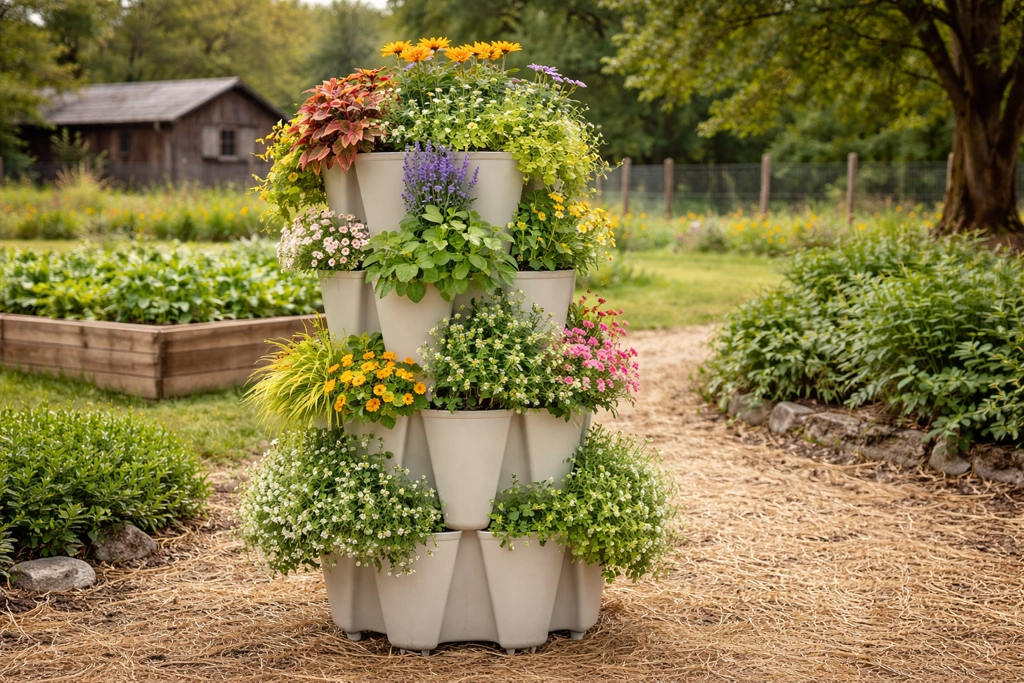
GreenStalk 5 Tier Vertical Garden Planter with Patented Internal Watering System
The GreenStalk system is what I wish I'd known about when I first started container gardening on our tiny back patio. This thing grows 30 plants in a 19-inch circle, which is genuinely impressive space efficiency. You're essentially stacking five tiers of planting pockets vertically instead of spreading dozens of pots across the ground.
What makes it actually work instead of being a gimmick is the internal watering system. You fill the top reservoir, and it distributes water down through all five tiers evenly. No more running around with a watering can trying to remember which pot you've already hit. For someone juggling kids, chickens, and a full-time job, that automation is worth real money.
The plastic is food-grade and UV-resistant (BPA, BPS, and PVC-free), made in the USA, which addresses the quality concerns I have with cheaper plastic containers. After researching these systems for several months, the GreenStalk consistently shows up in homesteading forums with multi-year success stories, not the one-season-and-done failures you see with knockoff vertical planters.
Two honest warnings: First, this is a significant upfront investment compared to buying a dozen fabric bags or plastic pots. You're paying for the engineering and the space-saving design. Second, filling five tiers requires about 5 cubic feet of potting mix, which is not a small expense if you're buying quality organic soil.
It's not ideal for everything-don't expect to grow full-size indeterminate tomatoes or sprawling melons in it. But for salad greens, herbs, strawberries, peppers, and compact vegetable varieties? It's probably the most efficient use of vertical space available for small homesteads.
This makes the most sense if you're genuinely space-constrained (apartment balcony, small patio, urban backyard) or if you want a kid-friendly garden where the lower tiers are at their height for easy participation.
- ✅ Allows you to grow 30 plants in just a 19-inch diameter footprint, making it an excellent solution for homesteaders with limited space, such as a balcony or small patio.
- ✅ The patented internal watering system distributes water from the top reservoir evenly to every tier, simplifying watering and conserving water.
- ✅ Made in the USA from food-grade, UV-resistant plastic (BPA, BPS & PVC-free), ensuring it's safe for growing edibles and will last for years.
- ✅ The tiered system is perfect for gardening with children, as the lower levels are at their height, allowing them to easily participate in planting and harvesting.
- ⚠️ The initial investment is significantly higher than buying individual pots or grow bags.
- ⚠️ Filling all 5 tiers requires approximately 5 cubic feet of potting mix, which is a considerable additional expense and effort to set up.
- ⚠️ Not suitable for very large or deep-rooted plants like indeterminate tomatoes, melons, or full-size root vegetables like potatoes.
What Actually Works on Our Homestead
After three seasons of side-by-side testing, here's my actual container strategy:
I use fabric grow bags for: Tomatoes (up to 10-gallon size), peppers, potatoes, leafy greens, and annual herbs near the house where I can water frequently. The superior root development and drainage make them worth the extra watering attention for these crops.
I use plastic pots for: Perennial herbs I'm overwintering, large sprawling plants that need structural support, and anything in my back garden where I can't check moisture daily. The water retention and durability make them the practical choice for less intensive management.
For seriously limited space: Vertical systems like the GreenStalk make sense when horizontal square footage is your main constraint, especially for compact crops and herbs that don't need deep root zones.
The truth is, you don't need to pick one system and stick with it religiously. Mix and match based on what each plant needs and where you're placing it. That's the honest answer, even if it's less tidy than declaring a single winner.
Quick Decision Guide: Which Container Should You Choose?
- Choose fabric bags if: You're growing root vegetables, you can water 1-2x daily in summer, you want the best root development, or you need compact storage in winter
- Choose plastic pots if: You need self-watering capability, you're growing large/heavy plants that need stability, you're overwintering perennials, or you can only water once daily
- Choose vertical systems if: You have less than 25 sq ft of growing space, you want to maximize plant count per square foot, or you need a kid-friendly garden at multiple heights
- Consider both if: You have varied growing conditions around your homestead (like I do) and can match container type to each location's watering access and plant needs
The Real Answer
There's no universal 'best' container-just better choices for specific situations. Fabric grow bags give you superior root systems and drainage at the cost of more frequent watering. Plastic pots offer durability and water retention but can cause root circling and heat stress.
For most homesteaders, the sweet spot is using both strategically. Put your high-value, fast-growing annuals in fabric bags where you'll see them daily. Use plastic for your set-it-and-forget-it perennials and distant garden spots. And if you're truly space-constrained, invest in a quality vertical system that solves multiple problems at once.
The plants don't care about picking sides in the fabric vs. plastic debate. They just want appropriate root space, consistent moisture, and good drainage. Whichever container delivers those three things for your specific situation is the right choice.
Start with what matches your watering schedule and available space. You can always expand your container collection as you learn what works best for your homestead's unique conditions.