We may earn a commission when you buy through links on this page, at no extra cost to you. How this works.
Homesteaders who spend months nurturing tomatoes, berry bushes, and young seedlings know the frustration of finding them stripped bare by deer, raccoons, or rabbits overnight. Motion-activated solar repellers offer a humane way to protect your garden by detecting movement and triggering ultrasonic sound or flashing lights that encourage animals to move on without harm, chemicals, or traps.
These devices rely on passive infrared sensors to detect body heat and motion, then respond with frequencies or bursts of light that most animals find uncomfortable but not dangerous. Because they run on solar panels and rechargeable batteries, they work day and night without wiring or frequent battery swaps - useful when your garden is far from an outlet or you want coverage across a large plot.
The challenge is choosing the right unit. Pack sizes range from single repellers for small raised beds to multi-unit kits for acre-scale coverage. Features vary: some models use only ultrasonic pulses, others add LED strobes or audible alarms, and a few include adjustable sensitivity or frequency bands to target specific animals. Price points span budget singles to premium bundles, and build quality affects how well they survive rain, snow, and UV exposure season after season.
This guide compares four verified solar repeller models with different coverage areas, feature sets, and pack configurations. Each product is linked to current verified details, so you can match the repeller to the size of your garden, the animals you face, and the level of customization you need to keep your plants safe.
Quick comparison
| 4-Pack Solar Ultrasonic Outdoor Animal Repellent with Motion Sensor | Check current price |
| Solar Ultrasonic Outdoor Animal Repeller, Waterproof with Flashing Light & USB Charging | See Solar Ultrasonic Outdoor Animal Repeller, |
| 4-Pack Solar Ultrasonic Outdoor Animal Repellent, Waterproof with Motion Sensor | See price and details |
Use the matching tool first
Start with Raised Bed Soil Calculator if you want to narrow the fit before checking current offers.
How We Chose the Best Solar Repellers
Choosing a motion-activated solar repeller that works in real garden conditions requires looking at a few practical factors before adding to cart.
Waterproof rating matters most because these units sit outside year-round. We focused on models with IPX4 or better ratings that can handle rain, morning dew, and sprinkler overspray without failing after one season.
Solar charging is standard, but backup USB charging adds flexibility during cloudy weeks or under tree cover where sunlight is inconsistent. Units that offer both options keep working when weather doesn't cooperate.
Motion sensor range and detection angle determine how much ground one unit can cover. Most sensors in this category detect movement 20 to 30 feet away within a 110- to 120-degree arc. Narrower angles mean more units to protect the same area. Wider range helps if deer approach from multiple directions.
Dual deterrent features - ultrasonic sound paired with LED flashing - create a stronger response than sound alone. Animals that ignore one stimulus often react to the combination, especially at dawn and dusk when they're most active.
All four options here use ultrasonic frequencies and motion activation as their core technology, so the real comparison comes down to pack size, charging flexibility, and build quality. Multi-unit packs offer better value per repeller and let you protect larger garden perimeters or multiple flower beds without buying separate singles. Build quality shows up in stake stability, panel durability, and whether the housing warps or cracks after a summer of sun exposure.
These criteria help narrow choices to repellers that stay functional across seasons and give you enough coverage without guessing how many units you actually need.
How to Place Solar Repellers for Best Results
Position your repellers where animals enter rather than where damage appears. Check fence lines for gaps, survey hedgerows and brush edges, and watch compost bins or fruit drops - these spots funnel wildlife into predictable lanes, and a unit placed three feet to the side of the trail will catch motion before the animal reaches your crops.
Angle each sensor downward slightly so the detection zone sweeps the ground plane where deer, raccoons, or groundhogs actually move. Most passive infrared sensors read heat signatures best at four to six feet of elevation, mounted on a stake or fence post. Space units twenty to thirty feet apart so their coverage overlaps by a few feet; this eliminates blind corridors and ensures an animal crossing the boundary triggers at least one device.
Solar panels need four to six hours of direct sun daily to charge the internal battery through cloudy stretches and winter. Face panels south in the northern hemisphere, and tilt them to match your latitude if the bracket allows. Shade from a tree canopy or building overhang will drain the battery faster than the panel can recover, leaving the unit silent by dusk.
Install repellers before animals establish a feeding routine in your garden. Once a deer learns that your lettuce bed is safe, the startle effect must compete with memory and hunger. Moving a unit ten feet every two or three weeks also disrupts habituation - an animal that hears the same ultrasonic pulse from the same post each night may begin to ignore it, but a repositioned speaker resets the novelty.
Raised beds, berry patches, and young saplings benefit from corner placement, creating a perimeter that catches motion from multiple approach angles. For larger plots, walk the boundary at dawn or dusk to spot fresh tracks, droppings, or bent stems, then place units upstream of that evidence so the deterrent activates before the animal reaches high-value plants.
Do Solar Repellers Work on All Animals?
Solar repellers work best on animals that rely heavily on hearing and are naturally cautious, including deer, raccoons, rabbits, skunks, and cats. Ultrasonic frequencies disrupt their comfort zone without causing harm, making them more likely to avoid the area. Flashing LED lights add an extra layer of deterrence at night, particularly for nocturnal visitors like raccoons and opossums.
These devices are less reliable against animals that have become habituated to human activity or are highly motivated by hunger. A deer accustomed to suburban yards or a groundhog with an established burrow nearby may ignore the ultrasonic pulses, especially if food is plentiful. In those cases, the repeller alone may not provide full protection.
Combining solar repellers with physical barriers improves results. Pairing ultrasonic deterrence with low fencing, garden netting, or raised beds creates multiple obstacles that discourage persistent animals. Strategic placement also matters - position units along known entry paths, near vulnerable plants, and at the height recommended for your target species.
Humane deterrence requires patience and consistency. Solar repellers deter rather than eliminate, so animals may test this product during the first few weeks. Regular repositioning and maintaining clean sensors help sustain effectiveness over time without resorting to traps or chemicals.
Maintaining Your Solar Repeller Through the Seasons
Keeping your solar repeller working reliably means paying attention to a few seasonal maintenance tasks. Dust, pollen, and debris on the solar panel can reduce charging efficiency, so wipe the panel with a damp cloth every month - especially during spring when pollen counts are high and in summer when dry dust settles quickly. A clean panel charges faster and keeps the internal battery topped up even on shorter winter days.
In late fall, check the battery charge indicator if your unit has one. Many repellers include a small LED that shows battery health. If the indicator is weak or the device seems to cycle on and off inconsistently, it may need supplemental charging before winter. Units with USB backup ports can be brought indoors for a quick recharge using a standard phone adapter, then returned to the garden with a full battery ready for colder months.
Most motion-activated solar repellers are built for year-round outdoor use, with weatherproof housings rated IP44 or higher. Still, inspect the mounting stake and housing after heavy rain or wind. Loose stakes reduce sensor accuracy, and pooled water around the base can shift the angle or allow mud to coat the panel. Push stakes firmly back into the soil and clear any obstructions from the motion sensor lens.
These simple steps extend lifespan and keep deterrence consistent through every season, so animals don't learn that the repeller goes quiet when you're not watching.
Frequently Asked Questions About Solar Animal Repellers
Solar animal repellers raise practical questions about battery life, pet safety, and real-world coverage - especially when you're planning protection for a backyard or garden that sees year-round wildlife pressure.
How long do solar repellers last on a full charge?Most units run for three to five days after a full solar charge, with performance extending further during long summer days. Expect shorter runtime in cloudy stretches or under tree cover, where the panel receives less direct sunlight.
Will the ultrasonic sound bother my dog or cat?The frequencies used in these repellers target wildlife hearing ranges, so most household pets notice little or no disturbance. Cats and dogs may detect the sound at close range, but they typically adapt quickly or ignore it.
Can I use these near my chicken coop?Yes. Solar repellers help deter raccoons, foxes, and other predators without harming chickens or interfering with their activity. Mount the unit facing approach paths rather than directly into the coop to avoid unnecessary triggering.
Do they work in winter?Waterproof models continue to operate in cold weather, but shorter daylight hours reduce solar charging. If snow covers the panel or overcast skies persist, USB recharging keeps the unit active until sunny conditions return.
How many units do I need for a half-acre garden?Each repeller typically covers 500 to 800 square feet of detection area, depending on sensor angle and terrain. For half an acre - roughly 21,780 square feet - plan on two to four units positioned at corners or entry points where animals are most likely to approach.
Secure Your Harvest with the Right Repeller
Choosing the right repeller comes down to matching the device to your garden's layout and the animals causing trouble. The four-pack option delivers the lowest cost per unit, making it practical for protecting larger plots or installing multiple devices around vulnerable beds. USB charging adds backup power when cloudy weather limits solar performance, a useful feature if your garden sits in partial shade or you face long stretches without sun. Waterproof construction matters most in wet climates or exposed locations where rain and humidity test durability over months of outdoor use. Flashing LED lights paired with ultrasonic pulses work especially well against nocturnal visitors like raccoons and deer that forage at dusk and dawn.
Match the repeller to your garden size first. Smaller raised beds or container gardens may need only one or two units, while sprawling vegetable plots benefit from overlapping coverage zones. Consider the animals you see most often - ultrasonic frequencies deter a wide range of wildlife, but adding motion-triggered lights increases effectiveness against creatures active after dark. Sun exposure also plays a role; gardens with consistent direct sunlight handle solar-only models easily, but shaded areas or regions with frequent overcast skies justify the flexibility of USB backup charging.
Humane deterrence protects your harvest without harming the animals that share your homestead. Motion-activated repellers create an uncomfortable environment that encourages wildlife to move along, preserving both your plants and the local ecosystem. Review the coverage range, power options, and weatherproofing of each model above to find the setup that fits your growing conditions and gives you reliable protection season after season.
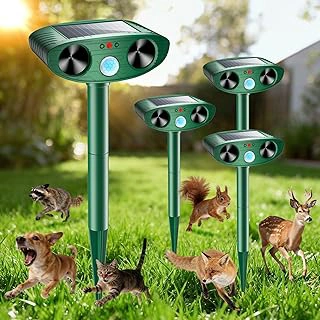
4-Pack Solar Ultrasonic Outdoor Animal Repellent with Motion Sensor
Covering a larger garden, multiple raised beds, or a chicken run often means buying several devices, which is where this four-unit bundle offers clear value. At $61.99 for the set, each repeller costs about fifteen dollars, making it one of the more affordable ways to protect several zones without running extension cords or swapping batteries.
Each stake in the pack uses a solar panel to power its motion sensor and ultrasonic emitter. When an animal crosses into the detection zone, the unit sends out high-frequency sound waves intended to discourage deer, raccoons, skunks, and similar visitors. The 4.4-star rating suggests buyers generally find the system effective, though performance depends on consistent sunlight reaching the panels.
Because these units rely entirely on solar charging - there's no USB backup or battery compartment - placement matters. A shaded corner under dense tree cover or along a north-facing fence will leave the devices underpowered and less responsive. Plan to install them where they receive several hours of direct sun each day, rotating their position seasonally if canopy growth changes light patterns.
The four-pack format suits homesteaders who need broad perimeter coverage: one stake near the vegetable beds, another by the berry bushes, a third protecting the orchard edge, and a fourth guarding the coop. It's also useful if you want to test different locations before settling on the most effective spots, since you have enough units to experiment without buying duplicates.
This set trades convenience features for economy. You won't find adjustable sensitivity dials, flashing LED alarms, or the ability to plug in during cloudy stretches. What you get is straightforward motion-triggered ultrasonic deterrence across multiple areas, as long as the sun cooperates and you're willing to manage placement with care.
- ✅ Four units for $61.99 provides lower per-device cost
- ✅ Motion sensor and ultrasonic output on each stake
- ✅ Covers multiple garden zones or larger perimeters
- ✅ Solar-powered operation requires no wiring or battery changes
- ⚠️ No USB backup or battery compartment for cloudy periods
- ⚠️ Requires consistent direct sunlight for reliable operation
- ⚠️ Lacks adjustable sensitivity or additional alarm features
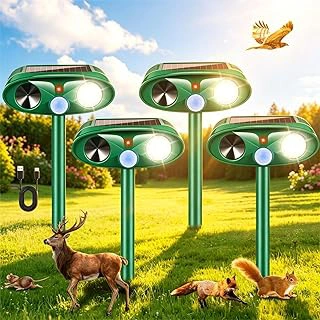
Solar Ultrasonic Outdoor Animal Repeller, Waterproof with Flashing Light & USB Charging
Gardeners dealing with tree cover, north-facing beds, or extended winter cloud stretches often find solar-only repellers sitting dark just when deer and raccoons are most active. This unit solves that gap with a USB charging port alongside its solar panel, so you can top up the internal battery indoors whenever sunlight runs short.
The waterproof housing guards the electronics through rain and snow, while the flashing LED light adds a second layer of deterrence - motion triggers both the ultrasonic pulse and a bright strobe that startles animals approaching at dusk. At $65.98 with a 5.0-star rating, the dual charging setup costs a bit more than solar-only models but removes the guesswork about whether your device will stay powered through a gray February week.
Mount it on the included ground stake near your most vulnerable plants - tomatoes, young greens, or bulb beds - and switch on the USB charger every few weeks during low-light months. The combination of sound and light works well for skittish animals like rabbits and squirrels; larger visitors such as deer may need the unit repositioned closer to their usual entry points to make the strobe effective.
If your garden sits under partial shade or you live where winter days are short and overcast, the USB backup turns this repeller into a year-round tool rather than a fair-weather option.
- ✅ USB charging backup ensures power during cloudy or shaded periods
- ✅ Waterproof construction for year-round outdoor use
- ✅ Flashing LED light adds visual deterrent at dusk and dawn
- ⚠️ Higher price point at $65.98 compared to solar-only units
- ⚠️ Requires periodic manual charging in low-light seasons
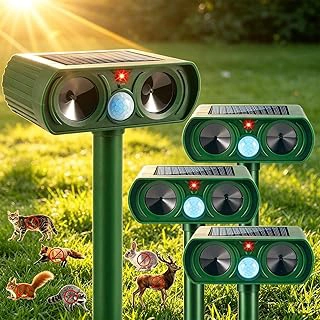
4-Pack Solar Ultrasonic Outdoor Animal Repellent, Waterproof with Motion Sensor
Heavy rain, spring humidity, and winter snow can destroy cheaper units in a single season, but this four-pack stands out for consistent weatherproof performance at $64.99. The waterproof housing protects the ultrasonic emitter and motion sensor from moisture damage, making it a reliable choice for orchards, berry patches, and vegetable rows that stay exposed year-round.
Each stake uses solar charging to power the ultrasonic frequency and flashing LED when motion triggers the sensor. The 5.0-star rating reflects dependable operation in wet climates where other repellers corrode or fail after sustained outdoor use. Deploying four units across a garden perimeter creates overlapping coverage that deters deer, raccoons, and larger animals before they reach your plants.
This pack works best for homesteaders managing high-traffic zones where animals approach from multiple directions. Space the stakes the listed size apart to cover orchard edges or long garden rows without gaps. Because the units handle freeze-thaw cycles and heavy downpours, you can leave them in place through multiple growing seasons without frequent replacement.
The waterproof design does add slightly more bulk compared to lightweight models, so driving the stakes into dense clay or rocky soil takes extra effort. Ultrasonic frequencies may take several days to condition animals to avoid the area, and some persistent wildlife may require repositioning the units closer to entry points. For year-round protection in challenging weather, the durability and four-unit coverage justify the investment.
- ✅ Waterproof housing withstands rain, snow, and humidity without degradation
- ✅ Four-unit pack provides overlapping coverage for larger gardens and orchards
- ✅ Solar charging eliminates battery replacement and wiring
- ✅ 5.0-star rating reflects reliable performance across multiple seasons
- ⚠️ Bulkier waterproof design requires more effort to install in hard soil
- ⚠️ Ultrasonic deterrence may take several days to condition animals
- ⚠️ Higher upfront cost at $64.99 compared to single-unit options
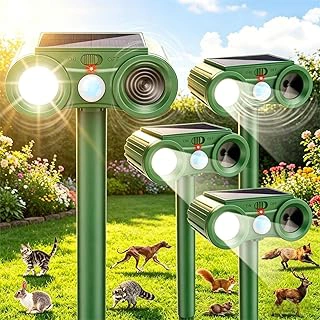
4-Pack Solar Ultrasonic Outdoor Animal Repeller with Motion Sensor & Flashing Light
Nocturnal garden raiders like raccoons, skunks, and opossums often strike when you're asleep, raiding compost bins, threatening chicken coops, and stripping berry bushes clean. This 4-pack combines ultrasonic sound with a motion-triggered flashing light to startle animals in low-light conditions when they're most active. Priced at $65.98 with a 5.0-star rating, the dual-mode approach creates two layers of deterrence: the ultrasonic frequency disrupts their comfort zone while the sudden light triggers an instinctive retreat response.
The solar panels charge during the day, so you won't need wiring or battery replacements - particularly useful when covering multiple problem zones across a larger homestead. The motion sensor activates both the sound and light when it detects movement, making the response immediate rather than constant. This intermittent activation helps prevent animals from becoming desensitized to a steady stimulus.
Four units let you create a perimeter around high-value areas: one near the compost, two flanking the coop entrance, and another protecting a raspberry patch. The flashing light component works best after dusk, when nocturnal animals rely on vision and sudden illumination disrupts their approach. Coverage is most effective when you position units at ground level where the motion sensor can detect low-profile animals rather than mounting them too high.
This setup suits homesteaders who've already tried single deterrents without success. The flashing light fills the gap that ultrasonic-only units leave during twilight hours, when animals are emboldened by fading daylight but still visually alert. If your problem animals are primarily daytime foragers like squirrels or rabbits, the light feature offers less advantage - but for those dealing with nighttime raids, the combination addresses the specific behavior window when damage occurs.
- ✅ Flashing light adds visual deterrent for nocturnal animals
- ✅ 4-pack covers multiple zones around compost bins, coops, or berry bushes
- ✅ Solar-powered with motion activation - no wiring or frequent battery changes
- ✅ Dual-mode approach works during low-light hours when many pests are active
- ⚠️ Light feature provides less benefit against daytime foragers
- ⚠️ Requires strategic placement at animal eye level for motion sensor accuracy
- ⚠️ Four units may not cover very large properties without gaps
What to Look for in a Motion-Activated Solar Repeller
- Waterproof rating (IP65 or higher) for year-round outdoor use
- Solar panel size and USB charging backup for consistent power
- Motion sensor range: look for 20 - 30 feet to cover garden rows
- Dual deterrents: ultrasonic sound plus flashing light for nocturnal animals
- Pack size: single units for small plots, 4-packs for larger gardens or multiple zones
- Adjustable frequency settings if you need to target specific animals