We may earn a commission when you buy through links on this page, at no extra cost to you. How this works.
Gilmour Pro Commercial 3/4" x 50' Heavy Duty Kink Resistant Garden Hose
Durable, kink-resistant rubber hoses that handle daily homestead work without splitting or tangling.
Use the matching tool first
Start with Raised Bed Soil Calculator if you want to narrow the fit before checking current offers.
Homesteaders know the frustration: you're halfway through watering the garden when your hose kinks, splits at the connector, or bursts under pressure. A cheap vinyl hose might last one season before it cracks in the sun or snags on every fence post. When you're managing livestock water, irrigating raised beds, or washing equipment daily, a flimsy hose becomes a costly this product.
Heavy-duty rubber garden hoses solve these problems. Unlike their lightweight counterparts, rubber hoses resist kinking even when dragged across gravel or left coiled in direct sunlight. Their thicker walls stand up to punctures from sharp edges and rough terrain. Brass or stainless steel fittings prevent the leaks and thread failures common with plastic couplings.
This guide compares five rubber hoses built for serious outdoor use. We focus on construction quality, kink resistance under real-world handling, available lengths for larger properties, and fitting durability. Each option balances weight against toughness, so you can choose the hose that fits your watering routine without replacing it every year.
Whether you need a 50-foot hose for garden beds near the house or a 100-foot model to reach pasture troughs, the right rubber hose will outlast vinyl alternatives and keep water flowing when you need it most.
Key Features to Look For in a Heavy-Duty Garden Hose
- Rubber construction for puncture resistance and all-weather flexibility
- Brass or stainless steel fittings (avoid plastic threads)
- Reinforced or multi-layer braided design to prevent kinks
- 5/8-inch diameter for good flow without excess weight (3/4-inch for high-volume needs)
- Length that matches your garden size plus 10-15 feet of slack
- Swivel fittings or anti-kink collars at connection points
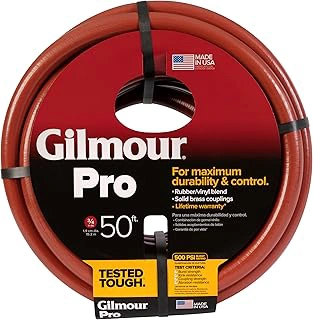
Gilmour Pro Commercial 3/4" x 50' Heavy Duty Kink Resistant Garden Hose
The Gilmour Pro Commercial earns its reputation among homesteaders who need a hose that can handle daily watering without constant wrestling. Built with a 3/4-inch inner diameter, it delivers noticeably higher water flow than standard 5/larger hoses - useful when filling livestock tanks or covering multiple garden beds in one session.
The brass fittings resist corrosion better than coated steel alternatives, and they thread smoothly onto spigots and spray nozzles without cross-threading. At the listed size, the hose reaches most mid-sized garden plots from a central water source without requiring extensions or dragging extra length.
Kink resistance comes from the hose's construction rather than marketing promises. The rubber wall thickness and reinforcement layers let it bend around fence posts and garden corners without collapsing the flow. It's not completely immune to kinking under sharp angles, but it recovers when straightened instead of holding a permanent crease.
The 4.4 rating reflects its balance: heavier than vinyl or hybrid hoses but still manageable for one person to coil and store. The weight also means it stays put when pressurized rather than snaking across paths. At $36.35, it sits in the middle tier - more than entry-level hoses but less than premium all-rubber models twice the price.
This hose fits homesteaders who prioritize flow rate and durability over portability. If you're watering chickens, filling raised beds, or running a sprinkler for pasture, the Gilmour Pro handles the routine without needing replacement every season.
- ✅ 3/4-inch diameter provides higher water flow for faster filling
- ✅ Brass fittings resist corrosion and thread smoothly
- ✅ 50-foot length covers mid-sized homestead watering tasks
- ✅ Recovers from bends without permanent kinking
- ⚠️ Heavier than vinyl or hybrid hoses
- ⚠️ Can kink under very sharp angles
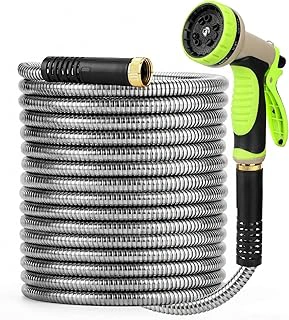
UNCO- 25 ft Stainless Steel Heavy Duty Metal Garden Hose with 10-Function Nozzle
For gardeners working in compact spaces on a limited budget, the UNCO 25 ft Stainless Steel Heavy Duty Metal Garden Hose offers a different approach to the kinking and puncture problems common in traditional hoses. While this isn't a rubber hose, its stainless steel construction reduces both issues entirely - metal simply doesn't kink or puncture the way fabric-reinforced rubber can.
The 25-foot length makes this hose practical for raised beds, small vegetable gardens, or potted plants on a patio. You won't drag excess hose through your rows, and the compact size stores easily on a hook or in a shed. The included 10-function nozzle adds immediate value, giving you spray patterns from mist to jet without buying a separate attachment.
At $19.85, this hose costs less than most premium rubber options while delivering on the core promise of durability. The stainless steel won't crack in the sun, won't develop soft spots, and won't need careful coiling to avoid memory kinks. The tradeoff is weight and flexibility - metal hoses are stiffer and heavier than rubber, which makes them less comfortable for extended watering sessions or maneuvering around obstacles.
This hose works best when you need reliable performance in a confined area and prefer to spend under twenty dollars. If your watering routine involves frequent repositioning or long reaches across uneven ground, the rigidity of metal may feel limiting compared to a supple rubber hose.
- ✅ Stainless steel construction won't kink or puncture
- ✅ Includes 10-function spray nozzle
- ✅ Budget-friendly at $19.85
- ✅ 25-foot length ideal for small gardens and raised beds
- ✅ Compact storage and no memory coiling required
- ⚠️ Heavier and stiffer than rubber hoses
- ⚠️ Less flexible for maneuvering around obstacles
- ⚠️ Shorter length limits reach in larger gardens
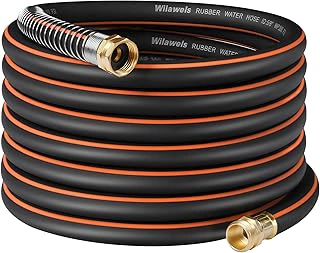
50FT x 5/8" Heavy Duty Rubber Garden Hose, 5-Layer Braided, All-Weather
This 50-foot rubber hose delivers year-round flexibility without the weight penalty that often comes with heavy-duty construction. The 5-layer braided design wraps a rubber core with reinforcement that resists punctures from sharp rocks, fence edges, and the rough surfaces common around barns and tool sheds. At 5/the listed size diameter, it pushes enough volume for filling livestock troughs or running sprinklers without the bulk of commercial hoses.
The all-weather rating proves useful when frost arrives early or the hose spends a hot afternoon coiled on concrete. Rubber stays pliable in cold snaps that leave vinyl hoses brittle, and the material shrugs off UV exposure that degrades lighter options over a season or two. The hose handles the temperature swings of outdoor storage better than hybrid models that stiffen below multiple°F.
At the listed size, you gain enough reach for most homestead tasks - garden rows, raised beds, or a couple of animal pens - without dragging excess length that adds weight and storage hassle. The braided layers add abrasion resistance when the hose drags across gravel or scrapes gate posts, extending usable life in rough-use areas where thinner hoses fail within a year.
For $45.99, this hose sits between budget vinyl and premium commercial rubber. The 4.4 rating reflects solid performance for homesteaders who need durability and weather resistance but don't require the extreme burst pressure or industrial fittings of contractor-grade options. It's a practical choice when you want a hose that works through all four seasons without constant babying.
- ✅ 5-layer braided construction resists punctures and abrasion in rough outdoor environments
- ✅ All-weather flexibility handles temperature swings from frost to summer heat
- ✅ 50-foot length balances reach and manageability for typical homestead watering tasks
- ✅ 5/8-inch diameter provides strong flow for sprinklers and livestock watering
- ⚠️ Heavier than hybrid hoses, requires more effort to move and coil
- ⚠️ Mid-range price may stretch budget for casual gardeners with lighter needs
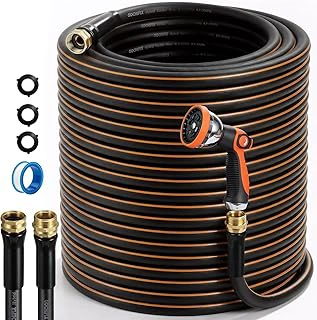
100ft 5/8" Heavy Duty Rubber Garden Hose with 10-Mode Spray Nozzle & Anti-Kink Swivel
A 100-foot hose solves the challenge of watering distant beds, filling troughs, or reaching the back corners of larger homesteads without dragging multiple shorter hoses or relocating spigots. This model pairs that extended reach with a 5/8" diameter rubber construction and anti-kink swivel fittings at both ends, addressing two common frustrations in long-hose setups: flow restriction and tangling at the connection points.
The anti-kink swivel design rotates independently of the hose body, which reduces twisting pressure when you pull the hose around corners or obstacles. Rubber construction adds puncture resistance compared to vinyl or hybrid materials, especially useful if the hose crosses gravel paths, rough wood edges, or brushy areas. The included 10-mode spray nozzle covers basic watering tasks without requiring a separate purchase, though most homesteaders will swap nozzles based on specific chores.
At $61.74 with a 4.4 rating, this hose sits in the mid-range for 100-foot rubber options. The primary tradeoff is weight and bulk: a fully extended 100-foot rubber hose is significantly heavier than longer versions and harder to coil or move between zones. This makes the hose better suited for semi-permanent installations - running from a main spigot to a large garden plot, orchard, or livestock area - rather than frequent repositioning. If your watering routine involves moving the hose daily between scattered beds or hauling it up and down slopes, a shorter length may prove more practical despite the extra reach this model provides.
The 5/8" diameter maintains reasonable flow for sprinklers and moderate-pressure tasks, though it won't match the volume of multiple/4" commercial hoses used for high-output applications. For homesteaders with sprawling properties who need reliable distance coverage and can dedicate a hose to one primary zone, this combination of length, rubber durability, and swivel fittings offers a workable balance between reach and material quality.
- ✅ 100-foot length reaches distant beds and back areas without extensions
- ✅ Anti-kink swivel fittings at both ends reduce twisting and tangling
- ✅ Rubber construction resists punctures from rough terrain
- ✅ Includes 10-mode spray nozzle
- ⚠️ Heavy and harder to move or reposition compared to shorter hoses
- ⚠️ Bulkier to coil and store
- ⚠️ 5/8" diameter offers less flow than 3/4" commercial options
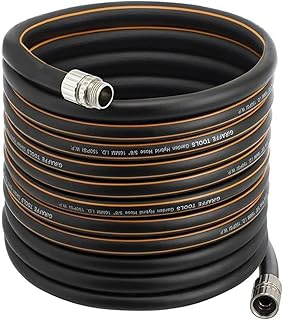
Giraffe Tools 75ft 5/8" Heavy Duty No-Kink Flexible Rubber Garden Hose
The Giraffe Tools 75ft 5/8" Heavy Duty No-Kink Flexible Rubber Garden Hose offers a practical middle ground for homesteaders who need serious reach without the bulk of a longer hose. At $59.79, this rubber hose targets flexibility and kink resistance while keeping maneuverability manageable across varied terrain.
The 75-foot length covers medium-to-large gardens, letting you reach from a central spigot to perimeter beds, livestock troughs, or greenhouse areas without constant repositioning. The 5/8-inch diameter delivers solid water flow for general watering tasks, filling buckets, and washing equipment. Rubber construction provides durability against scrapes on gravel paths, fence posts, and garden stakes - common hazards in active homestead environments.
Flexibility is the standout trait here. The hose curves smoothly around garden rows, wheel barrows, and raised beds without the stiff memory that causes traditional rubber hoses to fight you. This no-kink design reduces the frustration of stopping mid-task to untangle loops, though it won't reduces every kink if you make sharp bends or leave it coiled tightly in hot sun.
The 4.5 rating reflects strong overall performance, with most users noting the balance between heft and handling. This hose weighs more than vinyl or hybrid models but less than industrial rubber options, so you get durability without excessive drag when pulling it across your property.
Tradeoffs to consider: the listed size won't reach as far as the longest hoses in this category, and the flexibility that helps reduce the chance of kinks can make the hose feel slightly less rigid when stretched fully across uneven ground. The price sits in the mid-range, reasonable for rubber construction but higher than budget vinyl alternatives.
This hose suits homesteaders with established gardens who prioritize easy handling and kink resistance over maximum length. If your watering routes involve navigating around structures, tools, or plantings, the flexibility saves time and effort. For very large properties or users who prefer stationary hose placement, a longer or heavier-duty option may serve better.
- ✅ 75-foot length balances reach and maneuverability
- ✅ Flexible rubber resists kinking around obstacles
- ✅ 5/8-inch diameter provides solid water flow
- ✅ Durable construction handles rough homestead terrain
- ⚠️ Shorter reach than 100-foot options
- ⚠️ Heavier than vinyl or hybrid hoses
- ⚠️ Flexibility can reduce rigidity when fully extended
Our Top 5 Picks for Heavy-Duty Rubber Garden Hoses
Choosing a rubber garden hose that can handle daily homestead demands means weighing durability, length, and flexibility against your specific watering tasks. The five hoses reviewed here cover a range of serious outdoor needs without the frustration of constant kinks or punctures. The Craftsman Premium Rubber Garden Hose delivers dependable performance in a compact 50-foot length, ideal for smaller yards or gardeners who prioritize storage and maneuverability. For homesteaders on a budget, the Water Right 400 Series Rubber Garden Hose offers solid construction at a lower price point. The Continental ContiTech Industrial Rubber Hose stands out as a commercial-grade option built to withstand heavy use in demanding environments. When you need extended reach across larger properties, the Gilmour Pro Commercial Rubber Hose provides serious length without sacrificing material integrity. Finally, the Goodyear Premium Rubber Hose balances thick rubber construction with flexibility that makes daily coiling and handling less of a chore. Each hose addresses different priorities - whether that's portability, cost, industrial toughness, coverage area, or ease of use - so you can match the tool to your land and routine.
How to Choose the Right Heavy-Duty Garden Hose
Choosing the right heavy-duty garden hose starts with measuring the distance from your spigot to the farthest watering point in your garden, then adding 10 to 15 feet for slack and movement. A hose that's too short forces you to drag plants or containers closer, while excessive length creates coiling and storage problems you don't need.
Diameter directly affects water flow. A 5/8-inch hose works well for most homestead tasks like hand watering beds, filling troughs, and washing equipment. If you need to run multiple sprinklers simultaneously or fill large containers quickly, a 3/4-inch hose delivers higher volume but weighs more and costs more per foot. The tradeoff is speed versus manageability.
Rubber construction handles temperature swings and UV exposure better than vinyl or expandable hoses. It stays flexible in cold morning temperatures and resists cracking when left in the sun. Reinforced rubber hoses use multiple plies with fabric or cord layers between them, which prevents this product under pressure and reduces the chance of a kink becoming permanent.
Fittings matter as much as the hose itself. Brass couplings resist corrosion and cross-threading better than plastic, and they form a tighter seal that won't drip after a few seasons of connects and disconnects. Swivel fittings at the female end let the hose rotate without twisting the entire length, which helps prevent kinks at the spigot where most failures happen.
Kink resistance comes from wall thickness, reinforcement layers, and how the hose coils when stored. Hoses with thicker rubber walls and tighter reinforcement weave hold their shape under bending stress. If you frequently drag a hose around corners, through gates, or over rough ground, prioritize models that specify multi-ply construction or additional fabric reinforcement rather than relying on lighter single-layer designs.
Rubber vs. Vinyl vs. Metal: Which Material Lasts Longest?
Garden hoses fall into three main material camps, and each brings distinct tradeoffs to the table. Rubber hoses are built from natural or synthetic rubber compounds that deliver flexibility across a wide temperature range. They resist punctures from sharp rocks, thorns, and the edges of metal wheelbarrow frames. UV exposure wears them down more slowly than other materials, and they remain pliable in cold weather when vinyl hoses turn stiff. The downside is weight - a fifty-foot rubber hose can tip the scales at twenty pounds when empty, making coiling and moving it more of a workout.
Vinyl hoses are the budget option. Lightweight and inexpensive, they work fine for occasional light watering in protected areas. But vinyl kinks easily under its own weight, especially when the hose bends around fence posts or garden bed corners. Prolonged sun exposure causes the material to crack and split, often within a year or two of daily use. Cold temperatures make vinyl brittle, and sharp objects punch through the wall with little resistance.
Metal hoses - typically stainless steel - solve the kinking and puncture problems entirely. The interlocking steel jacket won't crimp, and thorns or gravel won't penetrate it. These hoses coil into a compact loop and take up minimal storage space. The tradeoff is flexibility: metal hoses don't drape around corners or curved bed edges as smoothly as rubber, and the steel exterior can become uncomfortably hot when left in direct sun. They also tend to be shorter in standard lengths, which limits reach on larger properties.
For homesteads where hoses get dragged across gravel driveways, left out in winter, and used daily for livestock water and garden beds, rubber offers the most reliable balance. It handles abuse without splitting, stays flexible enough to navigate obstacles, and lasts years longer than vinyl under constant UV and temperature swings. Metal hoses make sense in compact yards or patios where kink-free performance and storage size matter more than reach and all-weather flexibility.
How to Prevent Kinking and Extend Hose Life
Rubber garden hoses resist kinking better than vinyl, but proper handling makes the difference between years of reliable service and early replacement. Most kinking happens at connection points and where hoses bend sharply under pressure, creating weak spots that eventually split or restrict flow.
Store your hose coiled loosely or mounted on a reel when not in use. Flat storage or tight loops create memory curves that lead to kinks the next time you unroll it. A wall-mounted reel or freestanding cart keeps the hose off the ground and ready to use without wrestling tangles.
When watering, avoid sharp bends around corners or fence posts. Let the hose curve gradually instead of folding at hard angles. If you need to change direction quickly, reposition yourself rather than forcing the hose into a tight U-shape under water pressure.
Drain the hose completely before temperatures drop below freezing. Water left inside expands as it freezes, cracking the rubber and weakening fittings from the inside out. Disconnect from the spigot, lift one end above your head, and walk the length of the hose to push remaining water out.
Keep brass fittings clean and thread them on straight every time. Cross-threading damages the brass and creates leaks that let dirt into the hose interior. A quick wipe with a rag before connecting prevents grit from grinding into threads and seals.
Avoid dragging hoses over gravel driveways, concrete edges, or garden tool blades. Rubber resists punctures better than lighter materials, but repeated abrasion wears through the outer layer and exposes the reinforcement underneath. Lift the hose over obstacles or choose a different path when possible.
These steps take less than five minutes after each watering session and can double the working life of even a moderately priced hose. Heavy-duty rubber construction gives you durability from the start, but consistent care turns that durability into a decade of dependable use.
Frequently Asked Questions About Rubber Garden Hoses
Rubber garden hoses raise practical questions, especially for anyone managing a homestead or property that depends on reliable watering equipment year-round.
Are rubber hoses safe for drinking water?Yes, if the hose is specifically labeled as drinking-water safe or meets NSF standards. Not all rubber hoses carry this designation, so check the manufacturer's label before using it to fill livestock tanks, RV systems, or portable water containers.
How long do rubber hoses last?A well-maintained rubber hose typically lasts 5 to 10 years. Lifespan depends on UV exposure, storage habits, and how often the hose is dragged across rough surfaces. Draining after use and coiling loosely extends durability.
Do rubber hoses kink?Rubber hoses kink less than vinyl or expandable models, particularly when reinforced with fabric or wire layers. They hold their shape better under pressure, though sharp bends near fittings can still cause temporary restriction until the hose is straightened.
Can I leave a rubber hose outside in winter?Drain the hose completely before freezing temperatures arrive. Rubber tolerates cold better than vinyl and resists cracking, but water left inside will expand and damage fittings or weaken the inner tube. Store indoors or in a shed when possible.
What diameter is best for homestead tasks?A 5/8-inch inside diameter handles most jobs - watering gardens, washing equipment, filling troughs - without sacrificing flow rate. For high-volume needs like filling large tanks quickly, a 3/4-inch hose moves more water but weighs more and costs more upfront.
Making a Lasting Investment for Your Garden
Buying a heavy-duty rubber garden hose means spending more up front, but the payoff shows up every season you avoid dragging a kinked or leaking replacement out to the compost pile. Cheap vinyl hoses crack after one winter or split at the first sharp edge, turning what should be a simple watering task into a frustrating ritual of coiling, uncoiling, and patching. A rubber hose built with reinforced layers and brass fittings can handle years of daily use without the constant repairs.
The five hoses in this guide each serve a different need. If you work a small raised-bed garden and want something affordable that still resists kinks, the shortest option gives you maneuverability without excess weight. For homesteaders managing mid-sized plots and livestock water tanks, the 75-foot workhorse balances reach and handling. When you need to span a large property or reach distant garden rows, the longest hose here covers the ground without requiring multiple connections. The premium pick trades a higher price for flexibility that makes coiling and dragging across gravel or stone easier on your back and hands.
Before you order, measure the farthest point in your garden from the spigot and add ten feet for corners and movement around beds. Check whether your existing nozzles and sprinklers use standard threads or require adapters. Think about where you'll store the hose in winter and whether you have the strength to lift a fully loaded 100-foot rubber hose when it's time to drain and coil it. Match your property size and budget to the hose that covers your real watering routine, not an idealized version of it.
A well-chosen rubber hose turns a repetitive chore into a predictable part of your day. You stop worrying about leaks at the coupling or kinks that cut off flow halfway to the tomatoes, and you spend more time actually watering. That reliability makes the higher initial cost worth it, especially when you're managing animals, vegetables, and flower beds that all depend on consistent water access throughout the growing season.